


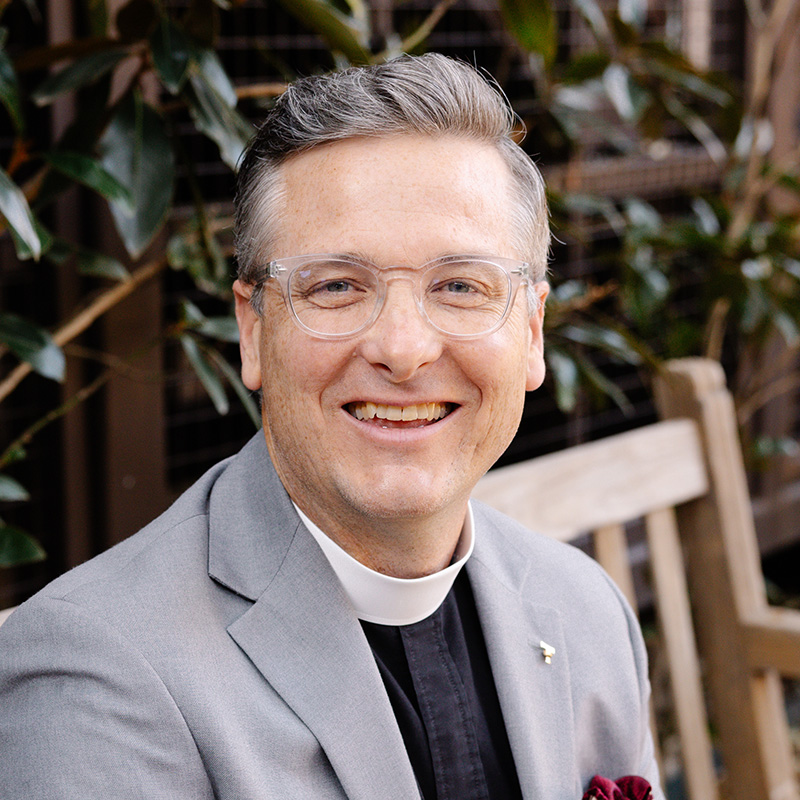
By Father Casey
In the runup to our nation's semiquincentennial, I've traded in reading the news for reading history. I wanted to reacquaint myself with the origins of the nation, and I also remembered the great quote by William Faulker that "the past is never dead; it's not even past." Or as James Baldwin put it, history is not something we read, so much as something we carry within us.[1]
I reread The Soul of America:The Battle for Our Better Angels by Pulitzer winner and fellow Episcopalian Jon Meacham. I read a collection of speeches by historian David MacCullough titled The American Spirit: Who We Are and What We Stand For. I read Our Declaration by Danielle Allen to reconsider the origin of our founding document and the famous phrases that sit like bedrock beneath our national identity. I read The Pursuit of Happiness by Jeffrey Rosen, which explores the deeper meaning of those famous words and the classical virtues upon which the founders sought to build the nation (wisdom, courage, temperance, and justice). And I read the Pulitzer winning biography of Frederick Douglass by David Blight, to learn more about one of the most influential figures in our nation's history, whose writings both soar and sear.
Each of these books has helped me connect with the history of our country, not merely to remember the past but to consider where we are and where we may be going. What I've noticed in all this reading is that our contemporary troubles are not so very different from where we've been before. We are experiencing staggering levels of income inequality today, but it's not so different from the late 1800s. We are witnessing the rise of nationalism, but so did the America of the early 1900s. There is growing isolationism and xenophobia today, but we've tuned out the world and turned our backs on immigrants before. There is a dangerous degree of demagoguery these days, but so too was there in the 1950s, when the nation was similarly enthralled to the whims of a bully.
I'm not trying to claim that we don't need to worry about what is happening around us – that "it will all work out in the end" – but rather that we've been here before, and history is a helpful pointer forward. I wish we took history more seriously as a nation, not as an exercise in fantasizing about a bygone era, but as a way of reckoning with where we came from and how we might find a better way forward.
In my meanderings through American history, I had also hoped to come across language to help us pray through this season of national life, especially this summer. As Episcopalians, we take great care in crafting the language of prayer, and with all the emotion and anxiety present these days, it feels that much more important to pray words that ring with truth and beauty. I was particularly hoping to find language we could pray together as a congregation this coming weekend. The standard forms of the prayers of the people from our prayer book are fantastic, and God, of course, knows what we need before we even ask. But if we become what we pray, which is something we believe as Christians, then what we pray in times like this has mystical power to shape our souls. Which is to say, we need to be praying for and about what matters most.
I was guided in my search by my wife, who directed me to a litany from nearly a century ago. Melody serves as Chief of Staff for Forward Movement, which is preparing to republish some of the prayers from the organization's first decade in a volume titled Prayers for Courage on the Way. Among them is a litany for the nation that was written in 1938, and Melody recognized the poignancy and power of these petitions. This shouldn't come as a surprise, for that decade was a time of great emotion and anxiety, too. There was rising nationalism, militarism, and authoritarianism around the world. Despair and cynicism was commonplace, and even the Church was struggling to speak with hope.
As I read this litany, I knew it was just what I needed to pray this weekend, and I hope you will come to share that feeling. The language is not contemporary – there are words and phrases that we don't commonly use anymore – but the sentiment still crackles with spiritual potency. I want to go ahead and share it with you, in hopes that this may provide you with words for your own prayers in coming days, and to familiarize us with the language ahead of Saturday and Sunday. I hope to see you this weekend, friends. Come and pray with me, that God will mend our every flaw and shed grace upon us all.
A Litany for the Nation (shared with permission from Forward Movement)
O God the Father, who alone art just and worthy to govern the nations upon earth; have mercy upon us.
O God the Son, thou light to lighten the nations and the glory of thy people Israel; have mercy upon us.
O God the Holy Ghost, spirit of unity, peace and concord; have mercy upon us.
O God who upholdest the nations that exalt righteousness, bless our country with a lowly sense of dependence upon thee, and of obedience to thy laws, so that we may justly love mercy and walk humbly with thee our God.
From presumptuous sin; from pride of possession; from vain-glorious boastings, and from national hypocrisies; good Lord, deliver us.
From the covetousness which is idolatry, from ruthless competition, and from the worship of mammon; good Lord, deliver us.
From class warfare and class hatred, from racial prejudices and antagonisms, from narrow partisanship, and forgetfulness of the common good; good Lord, deliver us.
From neglect of the aged and unemployed, from indifference to the foreign born, from cruelty to prisoners, and from all unbrotherliness; good Lord, deliver us.
We beseech thee to hear us, good Lord, that we may be given grace to seek first thy Kingdom and its righteousness, to know thy will and faithfully to perform the same; we beseech thee to hear us, good Lord.
That we may be ever mindful of the poor and oppressed in this and in every land, and may give gladly of our strength to support all people, everywhere, who are in darkness and the shadow of death; we beseech thee to hear us, good Lord.
That we may make choice of wise legislators and faithful councilors who soberly, justly, and with a godly spirit may enact things just and wise and merciful for the benefit of all people; we beseech thee to hear us, good Lord.
That we may join with other nations in striving for the defense and maintenance of human freedom, for the abolition of war, for the establishment of law and order, and for the general good of all whom you have made; we beseech thee to hear us, good Lord.
Accept, O Lord, our unfeigned thanks for the good land thou hast given us. Forgive us our transgressions, cleanse us from all things that defile our national life, and grant that this people whom thou hast so abundantly blessed may keep thy commandments, walk in thy ways and inherit thy peace; through Jesus Christ our Lord. Amen.
Casey+
——————
[1] "History, as nearly no one seems to know, is not merely something to be read. And it does not refer merely, or even principally, to the past. On the contrary, the great force of history comes from the fact that we carry it within us, are unconsciously controlled by it in many ways, and history is literally present in all that we do. It could scarcely be otherwise, since it is to history that we owe our frames of reference, our identities, and our aspirations." James Baldwin, "The White Man's Guilt," Ebony (1965).
Previous Articles

June 26, 2026
June 19, 2026
June 12, 2026
June 5, 2026
May 28, 2026