

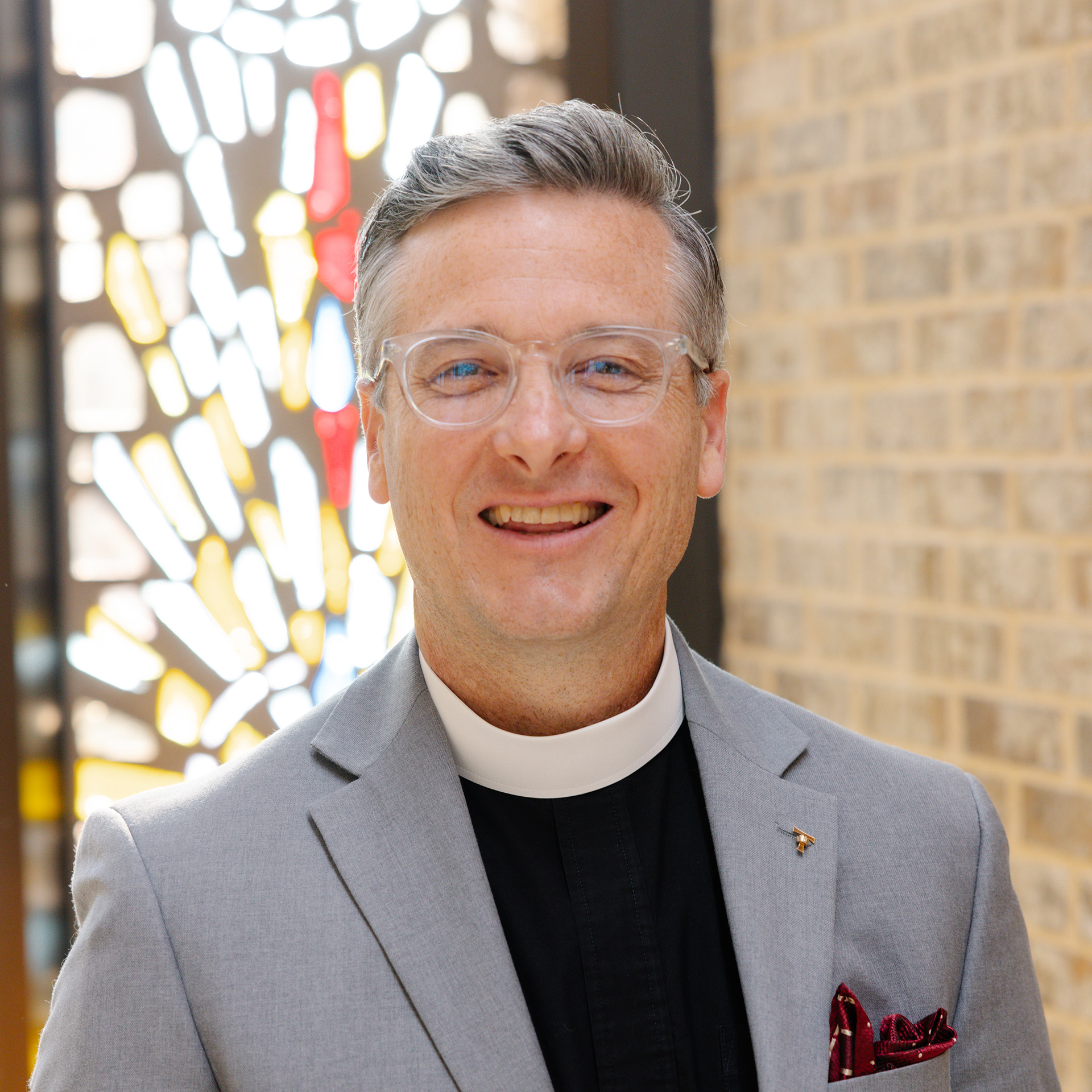
By Father Casey
I love to hike. It has always been a source of joy, and some of the most important times of my personal and spiritual growth have happened on trails. I hiked 1,100 miles of the Appalachian Trail after college; during sabbatical I hiked the West Highland Way in Scotland and the Via di Francesco in Italy; and last summer I began a quest to complete the Colorado Trail in segments (only 430 miles to go!).
This may sound strange, especially to those who don't do much hiking, but I actually prefer going up a mountain to coming down. Going up is more physically exhausting, especially if you're lugging a fully-loaded backpack, and yet I'd still rather go up a mountain than down one. Going up is hard; going down is dangerous. You can easily trip on a root or rock, or slip on a patch of gravel, and take a nasty tumble. And then there's the pounding on the knees and ankles. Yes, if I had to choose, I'd rather go up a mountain than down any day.
This Advent we're spending time with the prophets, and when you start paying attention to the prophets you realize that they have a lot to say about mountains. Isaiah, in particular, is filled with poetry about mountains, or rather, a mountain.
In days to come
the mountain of the Lord's house
shall be established as the highest of the mountains,
and shall be raised above the hills (2:2)On this mountain the Lord of hosts will make for all peoples
a feast of rich food, a feast of well-aged wines.
And he will destroy on this mountain
the shroud that is cast over all peoples,
the covering that is spread over all nations;
he will swallow up death forever. (25:6-9)They will not hurt or destroy
on all my holy mountain (11:9).
Isaiah isn't so much describing a place as a divine reality. What is the mountain? It is the summit of God's perfect presence, where the fullness of God is pleased to dwell. It is the locus of holiness, where God's goodness and love are fully known. It is the place of complete peace, where everything that separates and savages us is transformed. It is the complete revelation of who God is and what God desires for the world.
In the first decades of the Church, before the gospels had been written let alone canonized as Scripture, the early Christians read Isaiah like a gospel. They combed Isaiah's visions and recognized what, or rather who, they had been about. The mountain of the Lord is Jesus Christ. He is the summit of God's perfect presence. He is the locus of holiness. He is the source of all peace. He is the complete revelation of who God is and what God desires.
This meant two things. First, that instead of some far-off vision of something God would one day do, the mountain was before them. This wasn't a dream of a distant future; it was a description of what God had already done. So when Isaiah, for example, says that on this mountain weapons have no place and war is studied no more (2:4), they didn't dismiss it as futuristic fantasy or relativize it into a bunch of toothless pablum; they recognized that to dwell upon this mountain – to put on Christ – was to live its reality right now.
And second – and this brings me back to where I started – they understood that this mountain is to be climbed but not descended. It is one we are to go up and not come down. For the ascent is eternal, the summit is limitless, and the joy of dwelling upon it is unparalleled. It is not a mountain we hike over, a nice view briefly enjoyed, but rather our heart's true home.
So, if you feel like you're at the bottom of the mountain, take the first step. Begin the climb. And if you've been at it for a while and are wondering when you'll reach the top, don't give up or head back down. Descent only seems easier, but it brings greater pains. Yes, the climb is hard, and yes, it takes all that we have, but each step takes us higher, closer to our goal, nearer to the feast awaiting us at the top and the joy of the one who is the mountain.
Fr. Casey +
Previous Articles
January 16, 2026
January 9, 2026
January 2, 2026
December 26, 2025
December 23, 2025