

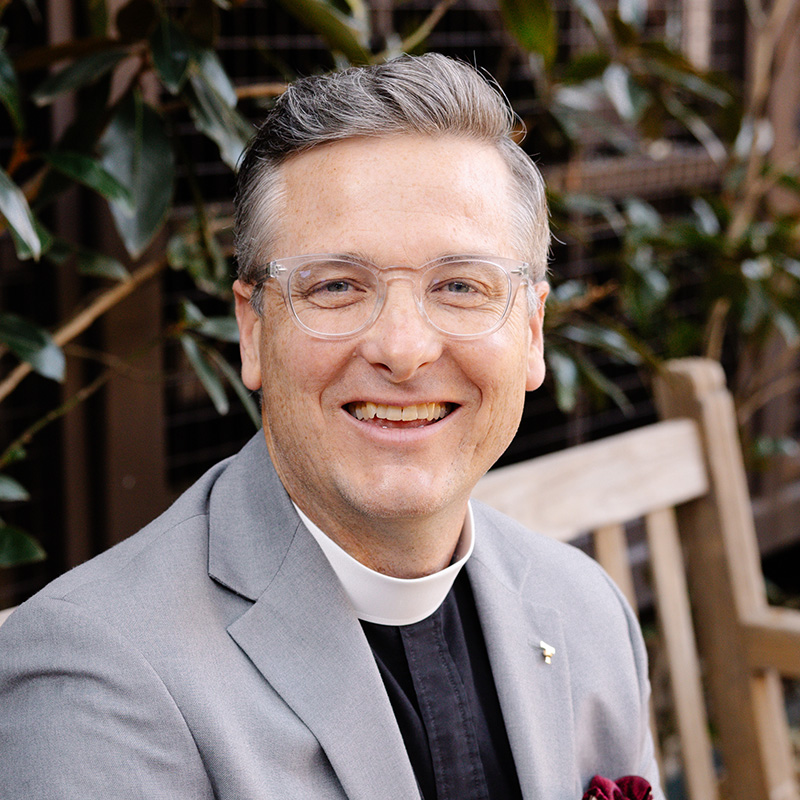
By Father Casey
This weekend we will enjoy the tradition of "Kirking of the Tartans" at our 11:15 service. Tartans are symbols of the Scottish clans, and "kirking" is from the Scottish word for church, and in this context means "blessing". So this is a fun way of honoring those with Scottish heritage, which includes our very own Episcopal Church, which I'll explain in a moment. But it is far more than just a celebration of history and heritage; it's also a symbol of our future hope, too, which makes it a wonderful thing to do as we approach Advent.
First, some brief history. After the Revolutionary War, Anglicans in the newly formed United States (who quickly swapped the name "Church of England" for "The Episcopal Church") desired to have an American-born priest be ordained as a bishop. Up to the war, custom held that all bishops be English, not colonial, and after the war they went back home. Bishops are essential to the life of the church – in the practical sense that they perform ordinations, and in the symbolic sense that they are connections to the apostles – so the leaders of the brand new Episcopal Church understood that something would have to be done.
So they sent a priest from Connecticut named Samuel Seabury (who makes a rather infamous appearance in the musical Hamilton) to England to seek ordination as a bishop. The English bishops there declined, as he couldn't take an oath of allegiance to the king, but after many months of discussion, a solution was found: he was sent to the Scottish Episcopal Church, which was historically connected to the Church of England but not under the authority of the crown (it is not to be confused with the Church of Scotland, which is Presbyterian). So Seabury traveled to Scotland, where in 1784 he was ordained by bishops of the Scottish Episcopal Church – on one condition: that the prayer book of the new Episcopal Church be fashioned after the Scottish rites. This led to our Eucharistic liturgies being much more "Scottish" than "English" in ways I won't bore you with here.
The bottom line is that, while we are commonly understood to be Anglicans, Episcopalians owe a great deal to the influence of Scotland. In history, heritage, and theology, we are rooted in Scotland, and so it is a good thing to honor this historic connection each year with a festive procession.
Yet, this tradition is not without a shadowside. More than a few are uncomfortable with the practice of processing tartans into the church. We tend to think of tartans as a charming fashion tied to ancestry. Anyone who's been to Edinburgh in recent years knows that you can hardly walk ten feet without passing a shop selling tartan apparel. But tartans are symbols of the clans of Scotland, and the history of the clans is not merely a story of heritage; it's also a story of tribalism and violence.
For centuries, Scotland endured horrific violence caused by inter-clan hatred. Petty squabbles routinely escalated to arms. Simmering feuds regularly boiled into terrible battles and awful atrocities. It wasn't just an "eye-for-an-eye;" it was often a "head-for-an-eye." One of my favorite places on earth is a gorgeous valley called Glencoe, deep in the Scottish Highlands. Tragically, Glencoe is also known as the "valley of weeping," as it was the site of massacre committed by Clan Campbell against Clan MacDonald as part of their long-running conflict.
My point is that tartans are not merely the romantic symbols we see today, but connected to the history of clan conflict. So is our kirking a form of historical whitewashing or the replacement of genuine history with romantic nostalgia? Not at all, and in fact, what we're doing is a beautiful symbol of hope.
The Christian faith is centered on redemption. We believe that through Christ every pain can be healed, every conflict can be reconciled, and every sorrow turned to joy. What is the cross, after all, but a tool of torment turned into a symbol of salvation? We believe in a God who overcomes the divisions of the world through the power of love. God does not leave us trapped in the ruts of resentment but shows us how to escape them through the force of forgiveness.
Which is why kirking the tartans is not just a bit of fun for those with Scottish heritage, but a poignant reminder of where we are eventually headed. All the things that formerly separated us will ultimately be transformed. Swords will become plowshares. Enemies will become friends. In the vision of heaven in the book of Revelation we read that before God at the end of days there is "a great multitude that no one could count, from every nation, from all tribes and peoples and languages," joined together in an eternal song of praise (7:9-10). The way things have been, and the way things too often still are, is not the way things will always be. People who once hated each other will become allies. Tribes that have always fought will know peace. Symbols that once signified conflict will become banners of love and praise.
So come this weekend and have some fun with us. If you have Scottish heritage, wear your tartan, and if you don't, pick up one of the banners and join in. This isn't only about where we came from; it's just as much about where we're going, and the calling to do all we can to bring that beautiful future to life today.
Fr. Casey+
Previous Articles
November 6, 2026
October 30, 2026
October 23, 2026

October 14, 2026

October 8, 2026