

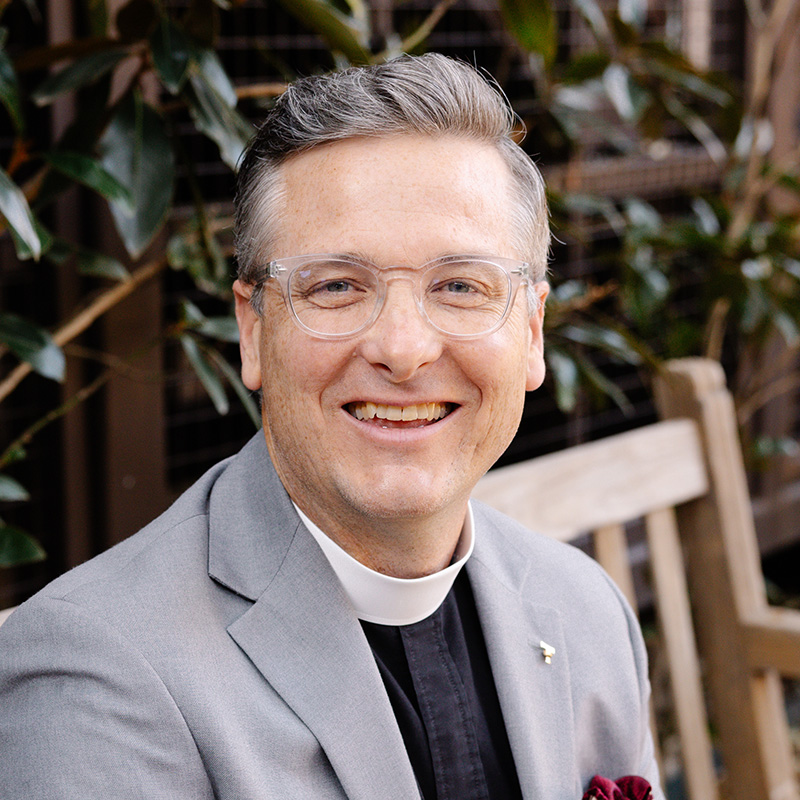
By Father Casey
When we choose to become Christian, we choose to orient our lives around the example of Jesus. Right and wrong stop being things we get to decide on our own. Goodness is no longer something we can do, or not do, depending on our whims. This is because a Christian's morality does not come from within, but rather from outside ourselves, from the way, the truth, and the life of Christ. Stated simply, to be Christian is to make Jesus the model for our morality.
Which means we must be careful not to treat morality like fashion, changing it depending on the modes of the times. If Jesus is our Lord, then we mustn't put his demands on our lives inside a box whenever they become inconvenient or unpopular. We don't get to turn off our discipleship to take part in things he never would, or to abstain from things that he always would. Because again, our understanding of right and wrong come from listening to the Lord, not from shifting public attitudes.
There have always been Christians who claimed to be acting in his name, yet whose morality hardly resembled Christ. There were the crusaders, lured by papal promises of heavenly rewards to enact slaughter and destruction. There were the wars of the Reformation, when zeal for hate frequently eclipsed the command to love. There was Germany during the rise of the Third Reich, when the Church became a puppet for Hitler and participated in his propaganda. This is the tragedy of Christian history, that so many times Christianity has born too-little resemblance to Christ. "Christianity has not produced Christlike people on any meaningful scale," a theologian once said to the writer Peter Wehner, and it's a statement that rings with truth and judgment.[1]
The absence of Christ from the morality of many Christians was on my mind again this week as I watched the news and heard fellow followers of Jesus defending things that seem so utterly unlike him. One particular example of moral dissonance stood out above the rest, namely, a recruiting advertisement from the Department of Homeland Security, which quotes from Jesus' Sermon on the Mount: "Blessed are the peacemakers, for they shall be called sons of God." I would normally be happy about an advertisement featuring one of the Beatitudes, but the work being promoted has nothing to do with Jesus. This is wickedness posing as righteousness, and no amount of slick media packaging or rhetorical gymnastics can change that truth. All you have to do is read the rest of the Sermon on the Mount (Matthew 5-7), not to mention the rest of the gospels, to know that Jesus has absolutely nothing to do with an armed paramilitary force, masked and unaccountable, terrorizing immigrants on behalf of the state.
As our new bishop, Rob Price, wrote to the diocese on the very first day of his episcopate, "An informed Christian conscience must recoil at the means by which federal officers are currently enforcing the policies and orders of the executive branch, and the conditions under which most detainees are being held – including, most disturbingly, minors."[2] I commend our bishop's letter to you, which reveals that he is prayerfully seeking to align his heart with Christ's, for that is the calling of every Christian: to pattern our lives on Christ.
No matter what verses of Scripture we quote, no matter how boastfully we brandish our religion, if our morality doesn't resemble Jesus then it isn't Christian. And the counter is also true: even when we aren't clothing ourselves in Christian symbols or slickly citing Scripture, if our words and ways are rooted in Jesus then we are bearing faithful Christian witness.
I invite you to join our bishop in praying for your heart to be like Christ's, and join him also in praying for all those who have been detained by the very ones recruited using the twisted words of the Lord. You may have noticed that we are praying for migrants in detention centers in our Prayers of the People – something Bishop Price has asked all the churches of our diocese to do. "Prayer must be the ground upon which we all stand together in solidarity and repentance," he writes. "Prayer is the Christian's first and best recourse, because it is the power given to us to ask for God's power to intervene in human suffering and injustice." And we needn't pray abstractly, either, for we know the names of some of the detained who are fellow Episcopalians from our own diocese: Juan, Jose, Pedro, Ayoub, Mo, Barbod, Milad, Sahel, Asra, Amir, Hana, and Sared. Pray for them like they were part of your own family, for through water and the Spirit, they are.
Knowing what is good and right is not always easy, especially in complicated times, but we know where we should always begin. Christian morality always starts with Jesus Christ. If something doesn't look like him, sound like him, seem like him, then it's safe to assume it's not for us. Better to steer toward the people and places he blesses in the Beatitudes, for that's a good way to know we're headed in the right direction.
Fr. Casey+
[1] Peter Wehner, "MAGA Jesus Is Not the Real Jesus," The Atlantic, January 21, 2026.
[2] https://edod.org/resources/articles/prayers-for-diocesan-parishioners-held-in-immigration-detention/
Previous Articles
September 25, 2026
September 18, 2026
September 11, 2026
September 4, 2026
August 21, 2026