

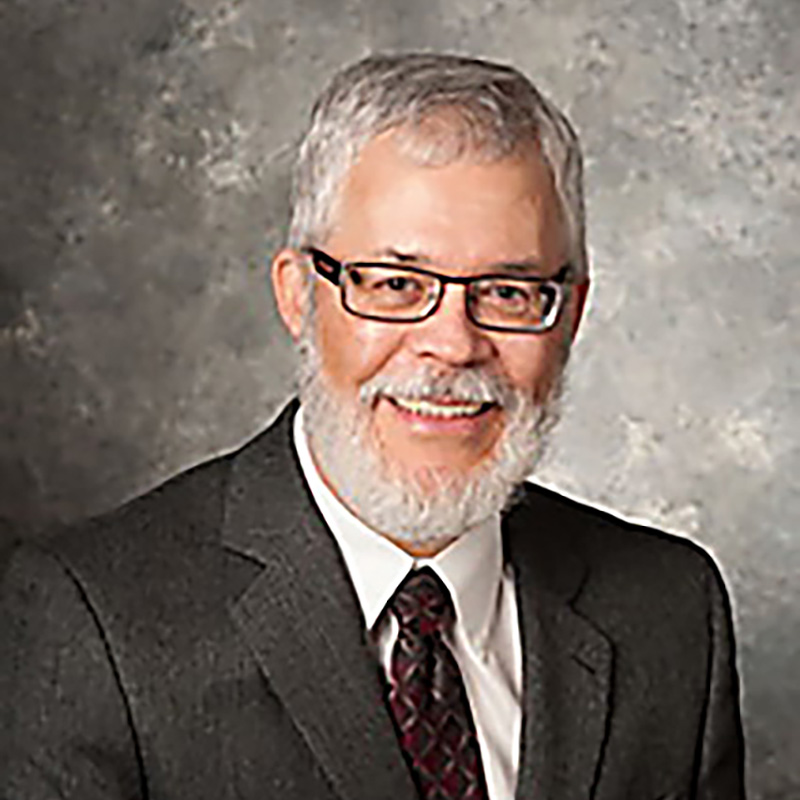
By The Rev. Mark W. Stamm
I love the work of eucharistic visitation ("EV") and have been advocating for this ministry for most of the past thirty years—as an ordained elder in the United Methodist Church, as a professor of liturgy at Perkins School of Theology, and now as a worshipper at Transfiguration. I've even written a book about the practice, Extending the Table (Discipleship Resources, 2009). Our EV ministry is based on our conviction that all of us need to receive the Body of Christ on a regular basis, both in the Eucharist and in the presence of our siblings in Christ when we gather together. Thus, the ministry of our EVs always begins when someone (i) looks around in worship and asks, "Who's missing?" and then (ii) takes the time to actually answer the question.[1]
Along with my wife, Margie, I serve as an EV at the Fig, and I'm blessed every time we share the sacrament in this way. We've been recipients as well, receiving Eucharist from Fig EVs during several illnesses and as we've recovered from surgeries. As we've been blessed to receive, so we feel blessed to serve. I learned of the Fig's amazing EV ministry before I began worshipping regularly with you. For amid the eucharistic fast imposed on all of us during the COVID-19 lockdown, Transfiguration distributed Eucharist to its members dispersed across more than 50 zip codes! When I learned of this, I contacted Mother Rebecca and asked, "Would you send Communion to us, as well?" Your willingness as a community to extend the table to our family is one of the primary reasons why Margie and I are a regular part Transfiguration today.
We know about Holy Eucharist among the first Christians from Scripture. Paul's First Letter to the Corinthians was written circa 54-55 CE, and it contains the earliest documentary evidence for the practice of Holy Eucharist. Paul writes to a community who, truly, had a mess on their hands, telling them – in essence – that their celebrations of the holy meal looked too much like secular gatherings held throughout the first-century Mediterranean world—hierarchical and patriarchal, favoring the rich over the poor, holding little regard for those living on the margins, those easy to forget (see I Cor 11:17-20). Paul insisted that if the Corinthian Christians were going to celebrate The Supper of their Lord, then it had to be different, reflecting the values of God's reign.[2] Like a good liturgist, first he took them back to their roots—"For I received from the Lord what I also handed on to you …" (I Cor. 11:23). Then he gave them a rubric, the first eucharistic rubric:
"So then, my brothers and sisters, when you come together to eat, wait for one another" (I Cor 11:33).
I like to imagine Paul asking the Corinthians to pause for a moment to cherish one another – each a precious member of the Body of Christ – then to take attendance, asking, "Who's missing?"
The first place we see something resembling our EV ministry occurs in a mid-second century Roman document titled The First Apology of Justin Martyr. There, Justin describes early Christians gathering, quite likely, in smaller assemblies meeting in homes. For these groups, it would have been clear when a member was missing. After describing the beginning of the service (what we know as "The Liturgy of the Word"), Justin goes on to describe the Liturgy of the Table, saying:
when we have finished the prayer, bread is brought, and wine and water, and the [Celebrant] . . . sends up prayers and thanksgivings to the best of his ability, and the congregation assents, saying the Amen; [then] the distribution and reception of the consecrated [elements] … takes place and they are sent to the absent by the deacons"[3] (emphasis added).
Justin goes on to describe how members gave offerings for distribution to those in need. In summary, we see an organized set of practices motivated by compassion, all flowing from the assembly of the faithful outward – first to its missing members and then to the wider community in need.
While smaller gatherings were characteristic of the church's earliest centuries, that's not our experience now. The shape and scope of our membership changes much more rapidly than we likely realize. While we don't notice significant changes from week-to-week, we welcome newcomers each week and we lose others over time. Some die, to be sure. Others move away to new communities and congregations, and we entrust them to the care of Christians in those places. Yet some who are missing have moved into nursing homes, retirement communities, or become homebound (either permanently or for a season). Given the scope and fluid nature of our community, it can be easy to lose track of people. Nevertheless, we are dependent upon one another to remain in communion, for we all share one Bread, one Cup.
So then, consider these things:
- If we're going to maintain these vital connections, we need all the baptized to ask, "Who's missing?" and, having asked, to share their responses to that question with our clergy and pastoral care staff.
- God may be calling you to serve as a Eucharistic Visitor. If so, I encourage you to reach out to Mtr. Rebecca and begin to help us respond as a community to the question: "Who's missing?"
Mark Stamm
———————————————–
[1] See Extending the Table, pp. 23-25.
[2] I invite you to read The Parable of the Great Dinner (Luke 14:15-24), The Parable of the Prodigal Son (Luke 15:1-3, 11-32) and The Rich Man and Lazarus (Luke 16:19-31) bearing in mind this critique of first century banquet practices. Through the Eucharist and other expressions of koinonia, God is forming us in how to eat together. Learning to do so is a vital part of our salvation and the salvation of the world.
[3] "The First Apology of Justin, the Martyr," paragraph 67, p. 287 in Early Christian Fathers, edited by Cyril C. Richardson (New York: Collier Books, 1970).
Previous Articles
March 20, 2026
March 13, 2026
March 6, 2026

February 27, 2026
February 19, 2026