

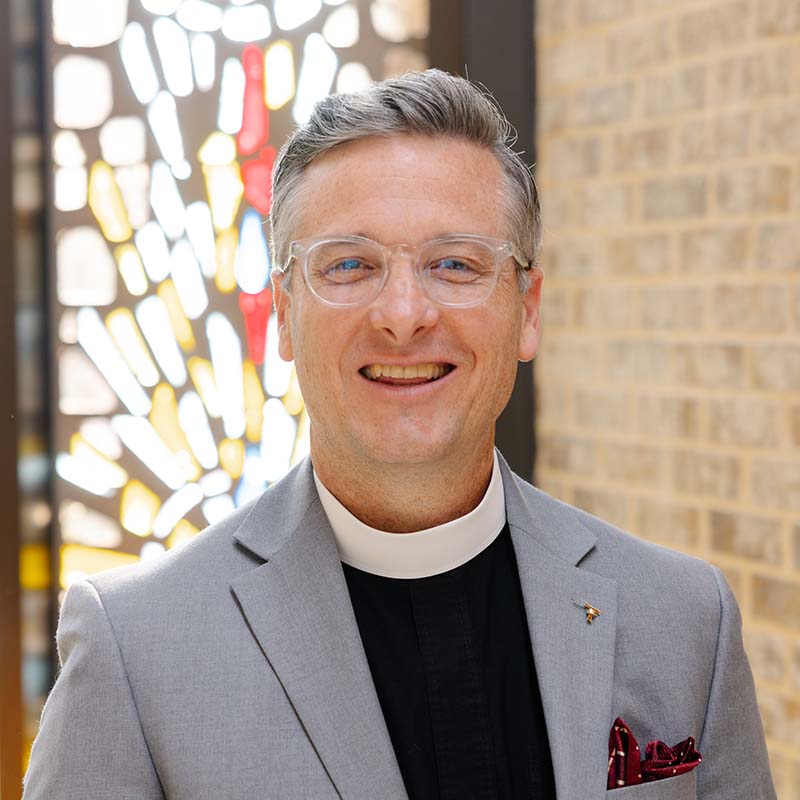
By Father Casey
This past week someone pretending to be me texted members of the vestry and staff asking for gift cards. It is the same scheme that has been used for years over email, and sadly, these sinful schemers wouldn't keep doing it if it didn't occasionally work. Please remember that if you ever receive a text or email from "me" asking you to send digital gift cards, it is a complete lie. I will never ask for your help in such a strange, cryptic way.
The first way to know it's not me is to pay attention to the sending email address or phone number. The message will almost certainly come from some made-up address and not my official church address, or from some strange phone number with no association to me. The name may appear to be mine, but they've simply attached my name to a phony address or number.
The second way to know is to read the message and ask, "Does this sound anything like Casey?" The thing about these scammers is that their messages are awkward and poorly written (forgive my pride in this regard!). They sound like they were written by a bot, because they usually are. They try to seem sincere, but they cannot conceal their falseness.
Unfortunately, there will come a time in the not-too-distant future when such scams will be harder to detect. The rise of AI is leading to a blurring of the lines between the genuine and artificial. AI can now pass the "Turing Test," the method first developed in the 1950s to distinguish human personality from machines.[1] Which means that we are entering an era when detecting the real from the fake will be much harder. Chances are good that you've already spoken with AI without knowing it, as quite a lot of customer service over the phone is now conducted by programs that sound incredibly lifelike.
Knowing how to tell the difference between the real and the fake is nothing new for Christians. Jesus called himself the "good shepherd," and said his sheep listen for his voice, but he warned about false shepherds who pretend to care about the sheep but come only "to steal and kill and destroy (John 10:1-10)." It's a teaching we'll hear again this weekend, and though the Church has had 2,000 years to practice, we still struggle to know the difference.
Perhaps what we need is a sort of "Theological Turing Test," a method of evaluation to help us know the difference between the voice of the true shepherd and all the other voices vying for our attention. I suggest starting with the same two methods I suggested for evaluating messages claiming to be from me.
First, look at the source and consider the authenticity. Is the origin Christlike? Does it derive from somewhere you know Christ typically dwells? That is, does it come from a place of force and power, or a place of gentleness and humility? Is it coming from the head of the table, or from the floor? Be suspicious of anyone claiming to speak for Jesus who seems utterly unfamiliar with the people and places where Jesus says he can be found (Matthew 25).
Second, ask yourself, "Does this sound anything like Jesus?" Does the voice claiming to be Christian sound at all related to the Sermon on the Mount (Matthew 5-7)? Does it seem to match the teaching to love all our neighbors – friends and enemies? Does it want us to grow more selfless or selfish? Does it foment anger or peace, vengeance or forgiveness? Sometimes those who boast the loudest of their Christian identity turn out to not know the difference between Holy Scripture and Pulp Fiction, and besides, you can find a Bible verse to support just about anything if you're willing to pull it out of context and detach it entirely from the witness of the gospels.[2] What matters most is not whether you can back something up using the Bible, but whether what you do resembles the Christ of the gospels.
In these tumultuous times, it's imperative that we pass our daily "theological Turing tests." We need to be able to tell the difference between the often quiet voice of the good shepherd and the loud voices of those who just want to command the sheep. Christ alone is the one who knows the way to pastures of peace. Christ alone is the one who leads us to refreshing waters in the midst of deserts of despair. Christ alone is the one who knows how to restore our wearied souls.
[1] https://www.nature.com/articles/d41586-025-03386-w
[2] https://publicwitness.wordandway.org/p/hegseth-borrows-violent-prayer-from
Previous Articles

July 30, 2026
July 24, 2026

July 10, 2026
July 3, 2026

June 26, 2026