

By Mother Rebecca
Last month, twenty-five members of Transfiguration made our way to Istanbul (not Constantinople 😉)[1], where we embarked on the travel portion of our pilgrimage in the footsteps of Paul. Each person's pilgrimage began long before we packed our bags and left our homes. I say "travel portion" because, unlike a vacation, a pilgrimage begins the moment we begin to think we might make it. For months before we departed, we met together to prepare our hearts, minds, bodies, and souls for the journey.
We began with misgivings. In his letters, Paul can sound abrasive, misogynistic, and even arrogant. Our preparation required us to learn more about this pivotal and troubling apostle. We appreciated the title (and the substance) of Karen Armstrong's excellent book St. Paul: The Apostle We Love to Hate. Through her book and many others, we were reminded that Paul never intended to write a systematic theology of the Christian faith. Rather, he wrote "occasional" letters addressed to particular people in particular places who were dealing with particular struggles. These letters reveal Paul's passion for Jesus, his abiding love for the churches he planted, and his growth as a disciple.[2]
Our itinerary was ambitious — twenty-two ancient and modern cities across approximately 1,900 miles, from the Seven Churches of Revelation in Asia Minor into Macedonia and Greece. We walked ancient streets, stood on the bemas where Paul was judged, and peered into the remains of cisterns and prison cells where he may have been held. We put our feet in the water at the ancient port of Kenchreai, from which Paul sailed to Syria when he left Corinth. 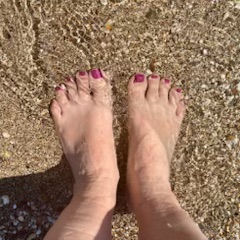 At each site, we read passages from Acts and from Paul's letters, and the Bible came alive as we read it on the ground in the places it was written.
There is no way to compress the fifteen pages of my yet unfinished travel journal into a newsletter article. So let me share one moment that stays with me.
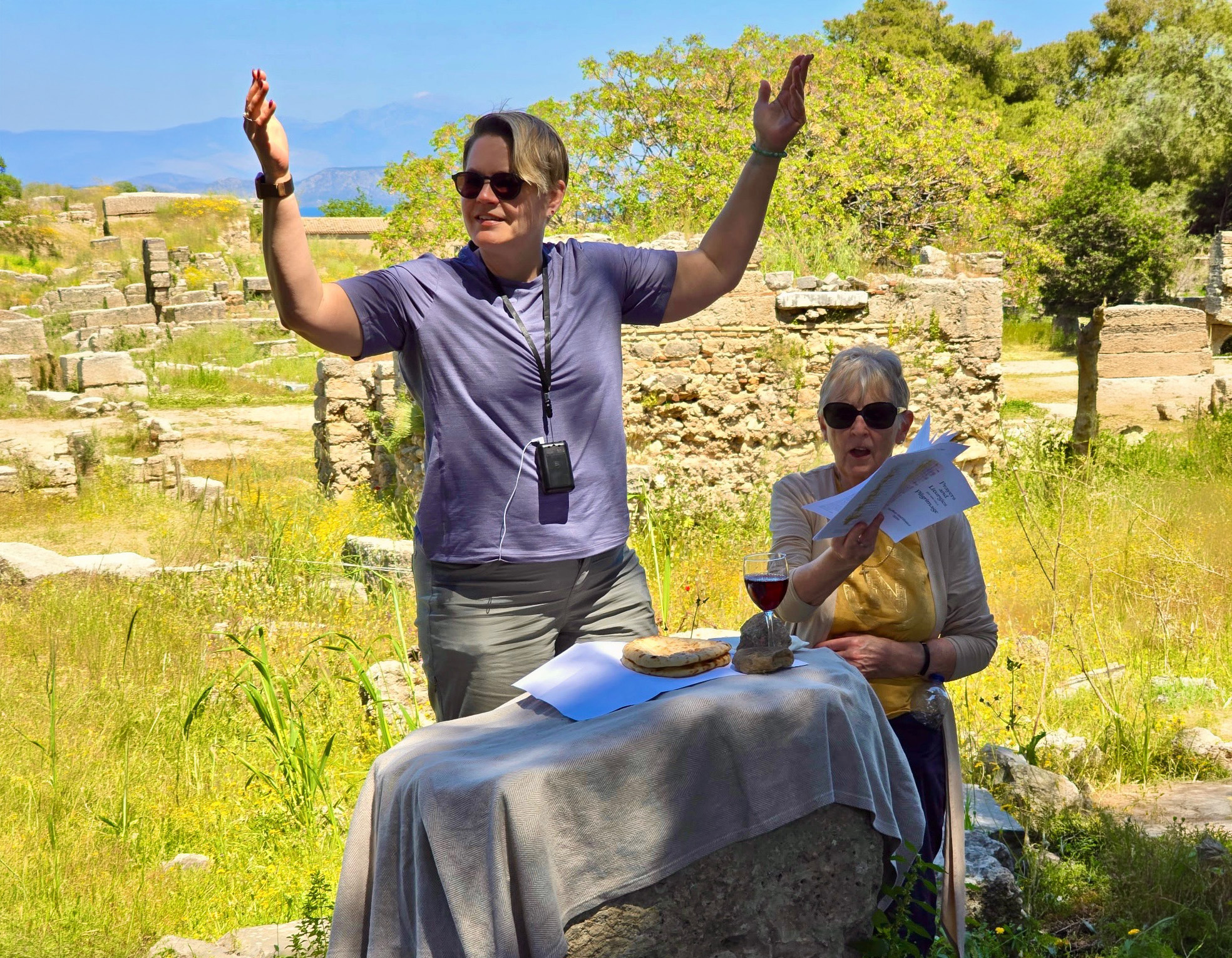
On the second Sunday of our journey, we found ourselves in Athens with a full schedule — the Acropolis, the ancient agora, the museums — and no room for a service of Holy Eucharist. Our guide suggested we delay by one day and worship at ancient Corinth, one of the few sites where visitors are permitted to hold religious services. The next morning, we gathered under a shade tree. A stone that once supported the walls of the city's forum served as our altar. Our bread — pita — had been generously donated by the owner of the restaurant where we'd shared lunch the day before. Our wine was a small bottle given by the hotel we'd left that morning. Mark Stamm shared the Gospel, Ginny Ward served as MC, and Lynn Walters served the chalice. It was a beautiful spring day, and the birds joined their voices to ours as we sang the Sanctus and the Lord's Prayer.
Paul first wrote about the Eucharist in his First Letter to the Corinthians — to the very community whose ancient stones surrounded us:
For I received from the Lord what I also handed on to you, that the Lord Jesus on the night when he was betrayed took a loaf of bread, and when he had given thanks, he broke it and said, "This is my body that is for[f] you. Do this in remembrance of me." In the same way, he took the cup also, after supper, saying, "This cup is the new covenant in my blood. Do this, as often as you drink it, in remembrance of me." For as often as you eat this bread and drink the cup, you proclaim the Lord's death until he comes (1 Corinthians 11:23-26).
Pita bread and hotel wine. A stone altar. Birdsong. The ruins of a city Paul loved and argued with and never stopped praying for. We have shared Eucharist in our beautiful church many times, and we will again. But that morning in Corinth, with the ancient world around us and the familiar words in our mouths, something old felt new. The table, it turns out, has always been this way — makeshift, borrowed, abundant.
The pilgrimage delivered many such moments. In the weeks ahead, I hope you'll ask our pilgrims about their experiences. What we carried home is still settling in us, and we would love to share it with you.
See you at services this weekend,
Rebecca+
—————-
[1] "Istanbul (Not Constantinople)" is a 1953 song, with lyrics by Jimmy Kennedy and music by Nat Simon. It was written on the 500th anniversary of the fall of Constantinople to the Ottomans. Through the years, it's been covered by Frankie Vaughan, Bing Crosby, Bette Midler, Pierce Brosnan and the Muppets (really, you can watch it here). My generation attributes the song to They Might Be Giants.
[2] For those struggling with Paul's writings as related to women, Jaime Clark-Soles has an excellent treatment of women who worked with Paul in Chapter 9 of her book Women in the Bible (Westminster John Knox Press: 2020).
Previous Articles
September 11, 2026
September 4, 2026
August 21, 2026
August 7, 2026

July 30, 2026