

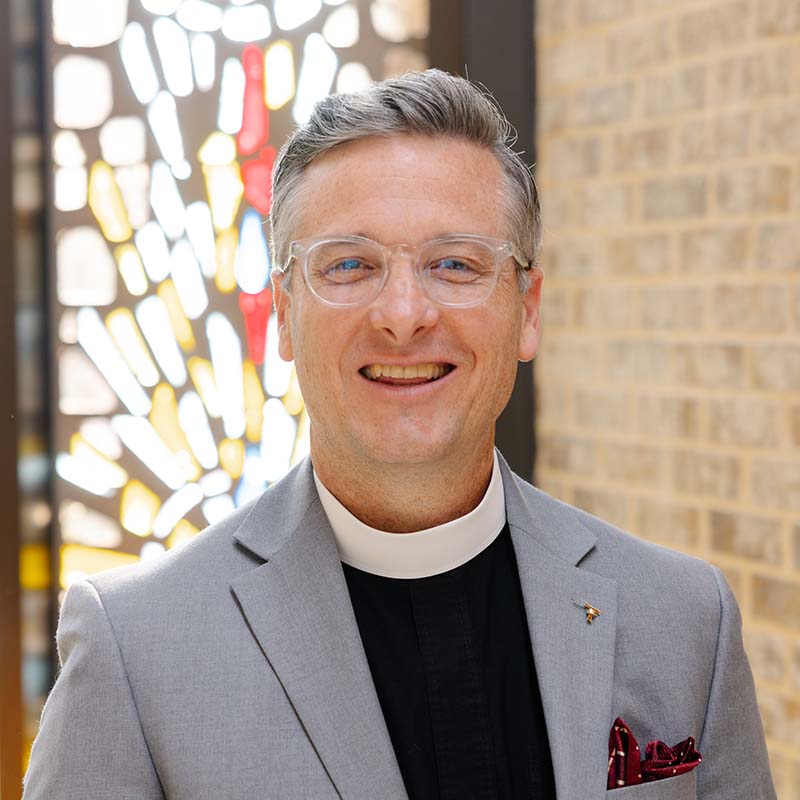
By Father Casey
What a magnificent Holy Week! Thank you to all who took part in our annual pilgrimage to the cross, and shared in the awe and joy of Easter Day. We need this glorious good news – that death has been defeated, that the worst thing will not be the last thing, that the peaceful way of Christ is, indeed, the true way of salvation – to steady ourselves in these chaotic and anxious times.
Easter is the hope that holds us up when we feel pulled down by the weight of our sinful world. It may seem like we're stuck in a Good Friday loop, but we know who has the last word: our crucified Savior. He did not win the world by weapons or warfare, but by far more powerful forces of love and forgiveness, and when he returned from the dungeon of death his first words were not "Get ready for payback," but rather, "Peace be with you."
It is, as the apostle Paul puts it, utter foolishness. How could might be defeated by weakness and violence be vanquished by mercy? Yet that is the heart of our hope, that "God chose what is foolish in the world to shame the wise; God chose what is weak in the world to shame the strong; God chose what is low and despised in the world, things that are not, to abolish things that are (1 Cor 1:27-28)." We are not saved by the destructive power of Caesar, but by the transforming power of love.
By the way, if you want to revisit any of our Holy Week services or sermons you can check out our YouTube Channel or find recordings anywhere you stream podcasts.
This coming weekend we'll ease further into the Great 50 Days of Easter. On Sunday, the new Bishop of Dallas, the Right Reverend Rob Price, will make his first formal visit to Transfiguration. This will be an important start to this new relationship, as the Bishop of Dallas has not made an official episcopal visit to us since 2018. In this service, Bishop Price will baptize an infant and confirm seven youth and twelve adults.
Which raises an important question: just what is Confirmation?
Allow me to offer a brief history of this ancient rite. Some of the oldest documents of the Church describe the making of new Christians in the first few centuries after Christ. Candidates would spend months or even years learning about the way of Christ, culminating on the night leading to Easter Day when they would be baptized and anointed with Chrism (special oil reserved for this purpose). They would then be robed in white and invited to share in the first Eucharist of Easter. Sound familiar? It's what we still do at the Easter Vigil to this day!
The only difference from then to now is the presence of the bishop. In those early centuries, the person performing all the baptisms was a bishop, someone ordained in a line of leaders tracing back to the apostles. But over time, bishops were no longer able to participate in all baptisms, or even to be near to all Christians with regularity. So bishops delegated baptism to priests, while reserving the laying on of hands and anointing for themselves. That act came to be known as "Confirmation" around the 5th century, and over the subsequent centuries, it slowly evolved into a sort of "part two" to baptism. Baptism began the process of becoming a Christian, which was finalized years later at Confirmation.
Our own Anglican tradition embraced this attitude until the 1970s. Before the 1979 Book of Common Prayer, Confirmation was required for full membership in the Episcopal Church. Only then could you receive communion, administer a chalice, serve as an acolyte, and so on. But in the second half of the 20th century, thanks to the rediscovery of those ancient Christian documents, the Church began to return to the earliest belief that baptism is full entry into the Christian faith and life. Which left the question: what about Confirmation?
Confirmation remains a sacrament (or sacramental rite, depending on your ecclesiology) for a few important reasons. First, it's an important part of catechesis, that is, how we teach the faith to others. If baptism is entry into the household of God, and we baptize small children, then it's essential that we help the baptized learn what it means to follow Christ. We need to learn how to practice what we've already been made by grace. This is why we wait to offer Confirmation until people are in high school, so they are ready to more maturely embrace the way of Jesus.
Second, Confirmation is a big part of sanctification, which means it's part of how we are made into holy people. It doesn't complete Baptism (which doesn't need a "part two" to be official), but it can move us deeper into the well of divine love. Just look at the words the bishop says over a confirmand: "Strengthen, O Lord, your servant with your Holy Spirit; empower her for your service; and sustain her all the days of her life. Amen." The bishop is not asking for the gift of the Holy Spirit, which was already received at baptism, but asking for the strength, the empowerment, and the sustenance of the Holy Spirit.
Finally, it is a way we are spiritually connected one to another, across the world and through the ages. The bishop who lays hands upon us in Confirmation is a descendant of the apostles, so Confirmation puts us into the great lineage of faith that traces its way back to our Lord. In this way, we are reminded that there is no such thing as a solitary Christian; we cannot and should not try to follow Christ on our own. Rather, we do this together in community, a community that is greater than our family, our congregation, our diocese, even our denomination, but the great community of the Church inaugurated at Pentecost.
So come and share in this second weekend of Easter. Come and celebrate once more the glorious good news of the resurrection. Join your prayers with the rest of the community baptized and confirmed into this beautiful faith. Together we can become what we have already been made, Christ's body in a broken world.
Fr. Casey +
Previous Articles
January 9, 2026
January 2, 2026
December 26, 2025
December 23, 2025
December 18, 2025